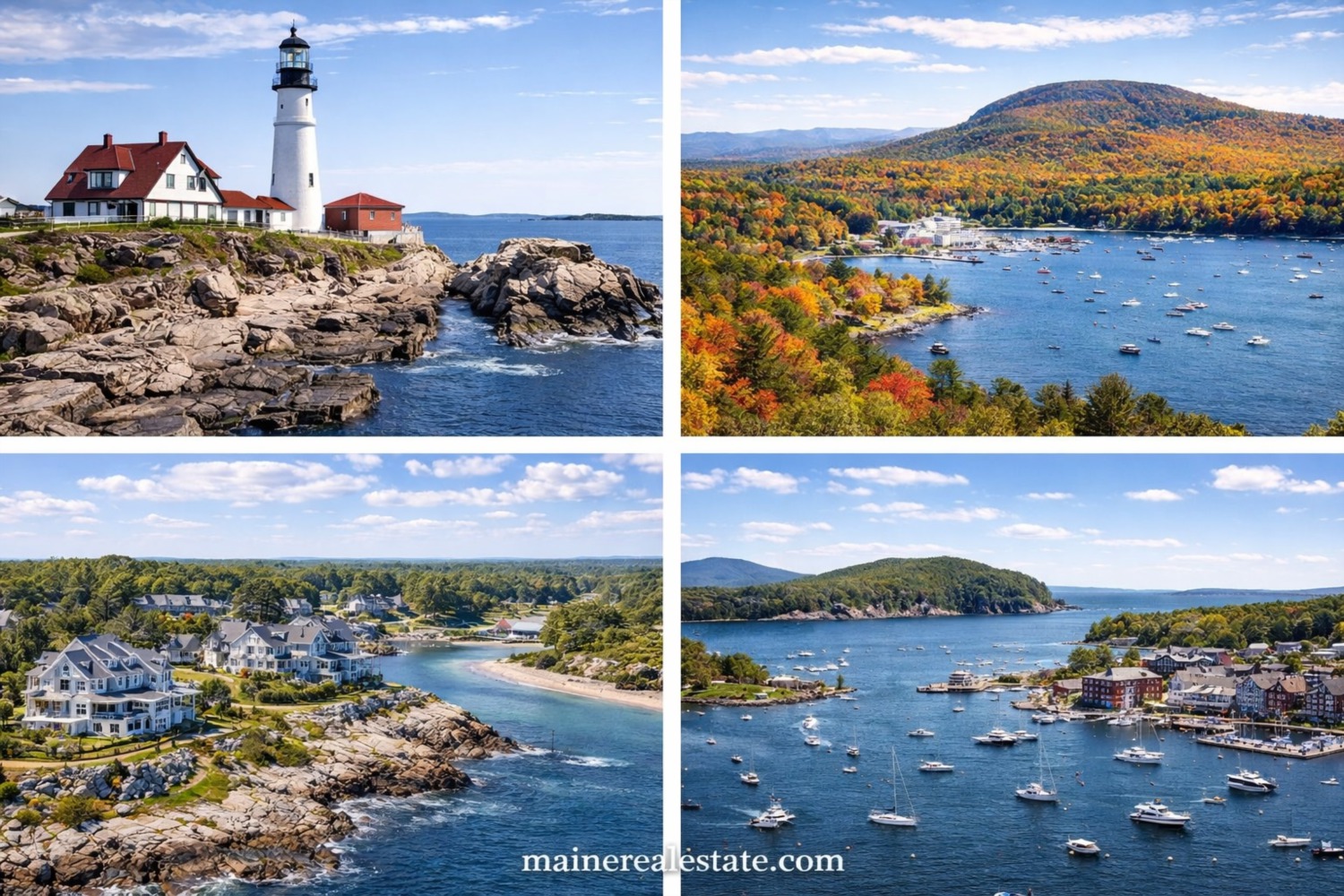
Maine covers nearly 35,000 square miles with dramatically different communities, landscapes, and price points. For buyers trying to decide where to focus their search, understanding which areas are attracting the most interest, and why, makes the process considerably more efficient. The most popular locations for buying real estate in Maine aren’t always the most expensive. Buyer interest in 2026 is spreading across the state as remote work, affordability pressures, and lifestyle priorities reshape where people choose to live.
This guide breaks down Maine’s most active real estate markets by region, explains what’s driving buyer interest in each area, and provides the current pricing and market data you need to evaluate your options.
Greater Portland and Southern Maine
The greater Portland area remains Maine’s most popular real estate market by nearly every measure: transaction volume, buyer demand, and economic activity. Cumberland County recorded 657 sales in the November 2025 through January 2026 rolling quarter, more than any other county in the state. Homes in Portland proper go to pending in around 9-10 days, dramatically faster than the 54-day statewide median.
Portland draws buyers with Maine’s strongest job market, the state’s best dining and cultural scene, walkable neighborhoods, and genuine urban amenities rare in a state this size. The city’s median home value exceeds $575,000, reflecting sustained demand from both local buyers and out-of-state relocators, particularly from Massachusetts and New York.
Surrounding towns each offer their own appeal at various price points. South Portland provides Portland-adjacent living at somewhat lower prices. Cape Elizabeth is known for top-rated schools and coastal beauty. Scarborough balances beach access with strong community amenities. Falmouth offers excellent schools and a suburban feel minutes from downtown Portland. Westbrook has seen significant investment in its downtown and draws buyers seeking urban energy at a lower price point than Portland. Freeport combines small-town character with strong schools and convenient access.
York County, immediately south of Cumberland, is Maine’s second most active market. Kennebunkport, Saco, Biddeford, and Old Orchard Beach serve different buyer profiles, from luxury coastal to affordable revitalizing downtowns. The county’s proximity to New Hampshire and Massachusetts makes it a natural landing point for New England relocators.
The Midcoast Region
Maine’s Midcoast stretches from Brunswick and Bath northward through Damariscotta, Rockland, Camden, and Belfast. This region is where many people picture when they imagine Maine: harbors lined with sailboats, mountains rising behind coastal villages, downtowns filled with galleries and independent restaurants.
Camden remains one of Maine’s most sought-after communities, with a rolling quarter median around $400,000 in Knox County. The town offers natural beauty, strong cultural programming, and an engaged community. Rockland has established itself as an arts and culture destination anchored by the Farnsworth Art Museum. Belfast attracts buyers drawn to its entrepreneurial spirit, farmers market culture, and walkable downtown at a lower price point than communities further south.
Bath and Brunswick sit at the southern end of the Midcoast and benefit from relative proximity to Portland (about 40 minutes). Brunswick, home to Bowdoin College, offers intellectual and cultural vitality. Bath combines maritime heritage with genuine livability. Damariscotta draws buyers with its active downtown and strong local food culture.
The Midcoast particularly appeals to remote workers, creative professionals, and buyers seeking coastal Maine character without Portland-area pricing. Internet infrastructure in these towns generally supports remote work, though buyers should verify speeds at specific properties.
Lewiston-Auburn and Central Maine
Lewiston and Auburn represent one of Maine’s most notable market stories in 2026. Androscoggin County’s 6.62% year-over-year price appreciation to a $346,500 median, combined with 206 sales in the rolling quarter, demonstrates genuine and growing buyer interest.
These twin cities offer Maine’s most accessible pricing within commuting distance of Portland (approximately 35 minutes via the turnpike). Both communities have seen meaningful downtown investment, with new restaurants, arts programming, and professional services expanding the quality of daily life. For buyers priced out of southern Maine, Lewiston–Auburn provides an opportunity to own property in a community with real services and genuine character at substantially lower cost.
Nearby, Kennebec County offers a similar value proposition. Waterville benefits from Colby College’s ongoing downtown investment, and Augusta provides state government employment. The county’s $315,000 median makes it accessible to a broad range of buyers.
Greater Bangor
Bangor is central Maine’s largest city and a regional hub for healthcare, retail, and services. Penobscot County’s $275,000 median and 370 rolling quarter sales make it one of Maine’s most active and affordable populated markets. Bangor offers genuine urban amenities, including regional healthcare at Northern Light Eastern Maine Medical Center, the Cross Insurance Center for events, and a growing restaurant and brewery scene.
Orono, home to the University of Maine, adds college-town character and cultural programming to the greater Bangor area. Hampden draws buyers with excellent schools, outdoor recreation, and a quieter residential feel while maintaining easy access to Bangor’s services.
For buyers seeking affordability with access to real services, the greater Bangor region offers a compelling proposition. The combination of low housing costs, regional employment, healthcare access, and quality of life makes it particularly attractive to remote workers, healthcare professionals, and those relocating from higher-cost markets.
Downeast and Acadia Region
Hancock County, encompassing Ellsworth, Bar Harbor, and communities surrounding Acadia National Park, draws a specific type of buyer: those for whom access to one of America’s most spectacular natural landscapes is a primary lifestyle priority.
Bar Harbor provides the closest residential access to Acadia’s trails, coastline, and mountains. The town maintains year-round community character despite significant seasonal tourism. Ellsworth serves as the region’s commercial hub with more affordable housing and practical services.
The Hancock County median of $419,500 positions this region between the premium southern coast and Maine’s more affordable inland markets. Buyers here accept greater distance from Portland and Boston in exchange for natural beauty and outdoor access that’s genuinely difficult to replicate elsewhere.
Western Mountains
Oxford County’s 11.73% price appreciation to a $342,500 median signals growing demand for Maine’s mountain region. Bethel, gateway to Sunday River Ski Resort, anchors this market. The appeal is straightforward: four-season outdoor recreation, mountain scenery, and a quality of life centered on the natural environment.
Buyers in the western mountains tend to be outdoor enthusiasts who prioritize skiing, hiking, and mountain biking over coastal access or urban amenities. The region is more affordable than coastal alternatives and attracts both year-round residents and vacation property buyers. As remote work has expanded the geography of where professionals can live, Bethel and surrounding communities have benefited from buyers who previously couldn’t justify the distance from employment centers.
Affordable Northern and Rural Markets
Maine’s northern and rural counties are seeing some of the state’s strongest percentage-based price appreciation, driven by buyers discovering exceptional affordability.
Aroostook County, with its $180,000 median, offers homeownership at prices that are increasingly rare anywhere in New England. Somerset County ($249,450) and Piscataquis County ($215,000, home to Greenville and Moosehead Lake) provide similar value with access to Maine’s wilderness interior.
These markets require honest assessment. They are remote. Employment options are limited to local industries, government, healthcare, and remote work. Services may require driving to larger communities. Winters are long and serious. But for buyers with flexible employment, the financial calculus is compelling: a home that costs $180,000 in Aroostook County would cost $565,000 in Cumberland County. That difference transforms a buyer’s financial picture.
How to Choose the Right Location
With markets this varied, choosing the right location requires honest self-assessment about priorities and tradeoffs.
Start with employment. If you commute to a physical workplace, your location options are defined by drive time. If you work remotely, verify internet quality before committing to any specific property. Maine’s broadband coverage is excellent in towns but inconsistent in rural areas.
Match your budget to realistic markets. If your budget is $300,000, focus on Androscoggin, Kennebec, Penobscot, or northern counties. If it’s $500,000+, you have options across southern and midcoast Maine. Being realistic about budget from the start prevents frustration.
Consider accessibility and services. Evaluate each community for the services that matter to you: healthcare access, school quality, walkability, transit options, and proximity to daily needs. Maine’s larger communities, including Portland, Lewiston, Bangor, and Auburn, offer the broadest range of services and accessible housing options.
Visit in multiple seasons. A town that’s charming in August may feel very different in February. If possible, experience your target community during winter before committing. Talk to residents about the realities of year-round living.
Work with a local agent. A knowledgeable Maine real estate agent understands the nuances that data can’t capture: which streets flood in spring, which areas have the best internet, where new development is planned. Local expertise is particularly valuable in a state with this much geographic diversity.
Frequently Asked Questions
What is the most popular place to buy a home in Maine?
The greater Portland area in Cumberland County is Maine’s most popular market by transaction volume, with 657 sales in the most recent rolling quarter. The region attracts buyers with its job market, cultural amenities, and coastal access. However, significant buyer interest is also driving strong activity in Androscoggin County (Lewiston–Auburn) and Penobscot County (Bangor).
Where are home prices rising fastest in Maine?
As of early 2026, the counties with the strongest price appreciation include Piscataquis (up 26.47%), Somerset (up 13.39%), Aroostook (up 12.57%), Oxford (up 11.73%), and Androscoggin (up 6.62%). These are generally Maine’s more affordable or recreation-oriented markets where buyers are discovering value.
Where should I buy in Maine if I work remotely?
Remote workers have the broadest set of options. Popular choices include midcoast towns like Belfast, Camden, and Bath for coastal lifestyle; Bethel for mountain access; Waterville and Bangor for affordability with services; and Lewiston–Auburn for value near Portland. Always verify high-speed internet availability before committing.
What are the most affordable places to buy in Maine?
Aroostook County ($180,000 median), Washington County ($210,000), Piscataquis County ($215,000), and Somerset County ($249,450) offer Maine’s most affordable markets. Among more populated areas, Penobscot County (Bangor) at $275,000 and Kennebec County (Augusta/Waterville) at $315,000 offer affordability with access to services and employment.