
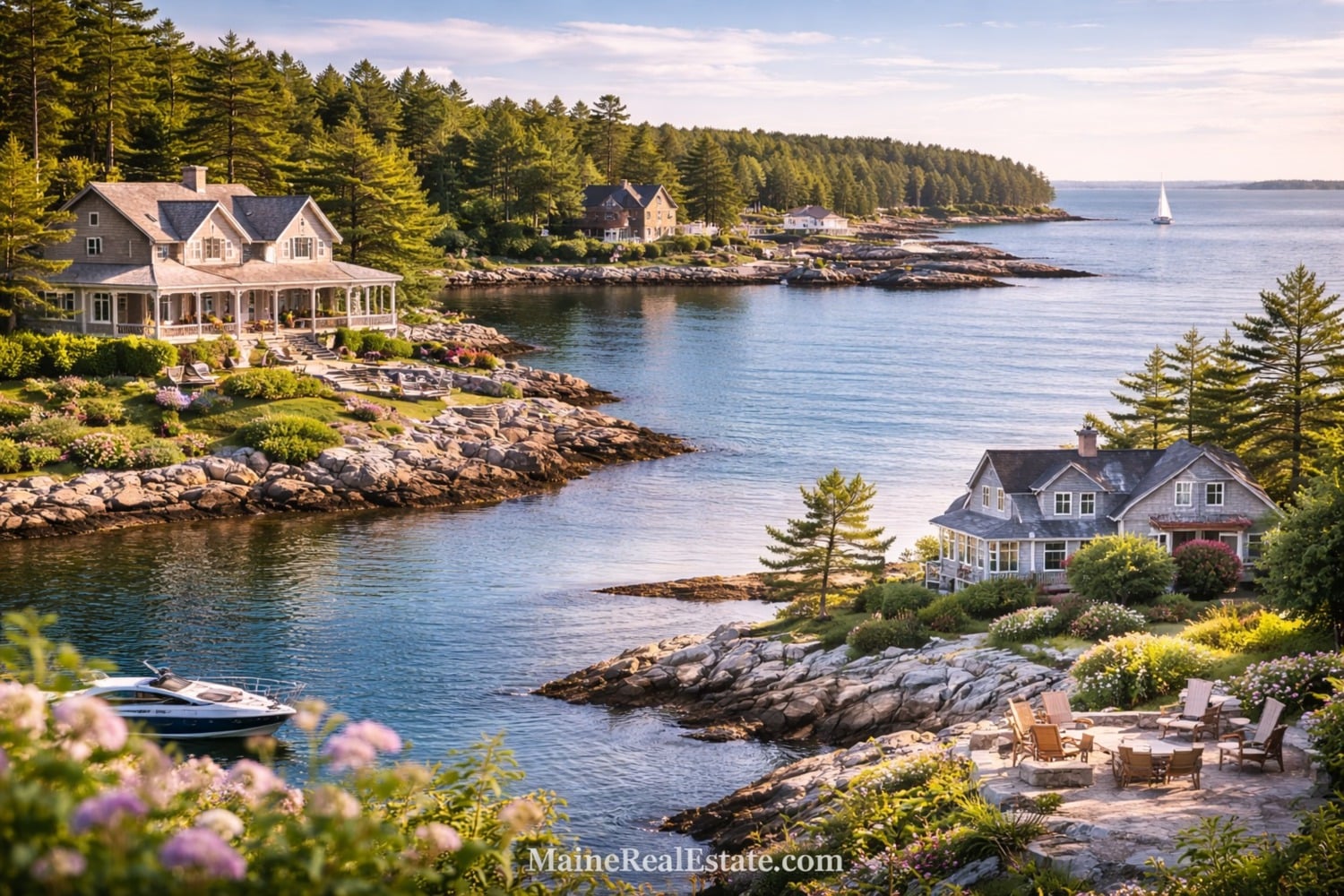
The Allure of Maine Waterfront Living
There’s something undeniably magical about waterfront living in Maine. Maybe it’s the crisp salt air that carries the scent of ocean pine. Maybe it’s the morning sight of water reflecting the first light of dawn, or the year-round soundtrack of lapping waves and migrating waterfowl. For many, a Maine waterfront property represents far more than just a real estate investment, it’s a lifestyle investment, a connection to one of America’s most pristine natural landscapes, and a meaningful place where memories unfold across the seasons.
Maine’s relationship with its waters runs deep. With 3,478 miles of coastline, more than California, if you count the islands and inlets, the state has woven water into its identity. The rugged Atlantic coastline, thousands of pristine lakes and ponds, and meandering rivers create a diverse portfolio of waterfront living options. Whether you’re drawn to the dramatic rocky cliffs of the Downeast coast, the charming harbor towns of the Midcoast, or the peaceful serenity of a remote lakefront property, Maine offers something that resonates with the waterfront dreams of virtually every buyer.
But purchasing waterfront property in Maine is different from buying a suburban home. It requires specialized knowledge, careful consideration of environmental factors, and an understanding of Maine’s unique regulations and market dynamics. This guide walks you through everything you need to know to make an informed decision about Maine waterfront living.
Types of Waterfront Property in Maine: Understanding Your Options
Maine’s waterfront properties come in distinct varieties, each with unique characteristics, appeal, and considerations.
Oceanfront Properties
Oceanfront homes sit directly on Maine’s Atlantic coastline, offering unobstructed ocean views and direct access to the sea. These are the crown jewels of Maine waterfront real estate, commanding the highest premiums and attracting buyers worldwide.
The appeal of oceanfront living is visceral. You wake to ocean views, fall asleep to the sound of waves, and enjoy changing light shows throughout the day. Summer and early fall deliver brilliant azure waters and lively coastal activity. Winter offers something equally appealing to many: a stark, dramatic seascape that feels timeless and remote.
Oceanfront properties range from modest cottages perched on granite ledges to sprawling estates in towns like Kennebunkport and Bar Harbor. Some sit high on rocky bluffs, naturally protected from storm surge. Others occupy lower elevations, requiring more refined flood protection and erosion mitigation strategies.
The trade-offs are real. Oceanfront properties demand constant vigilance against salt air corrosion, storm damage, and rising sea levels. Building and renovation costs run higher due to the harsh environment and strict coastal regulations. And the market can be volatile: what appreciates steadily in stable periods may face headwinds as climate concerns rise.
Lakefront Properties
Maine’s lakes offer a gentler waterfront experience than the ocean, yet maintain remarkable beauty and recreational value. The state boasts thousands of lakes and ponds, with Sebago Lake, Moosehead Lake, and Rangeley Lake standing as the crown jewels.
Lakefront properties offer year-round appeal. Summer brings boating, swimming, fishing, and water sports. Fall delivers mirror-like reflections of blazing foliage. Winter transforms lakes into ice highways for snowmobiling and ice fishing. Spring brings the return of birds and wildlife.
Lakefront homes tend to be more affordable than comparable oceanfront properties while offering equally stunning water views. The water stays calmer than the ocean, making lakefront living feel more peaceful and protected. Ice-out season, typically April or May, marks a celebrated community event across lake regions.
The market for lakefront property in Maine is exceptionally strong right now. Sebago Lake, Maine’s second-largest lake and closest major body of water to Portland, has seen particularly heated activity. The town of Standish, with substantial Sebago Lake frontage, experienced a remarkable 41% increase in sales volume in recent years, as remote workers and residents discovered lakefront living within driving distance of urban amenities.
Riverfront Properties
Maine’s river properties occupy a special niche, offering a different character than ocean or lake homes. Rivers provide views and water access without the expense of oceanfront or the exposure of larger lakes. Many riverfront properties sit on gently flowing waters perfect for kayaking, canoeing, and fishing.
Riverfront properties appeal to those seeking privacy and natural beauty without the fishbowl feeling of high-traffic lake communities. The Kennebec River, Androscoggin River, and Penobscot River all feature residential properties with excellent access and moderate pricing compared to ocean or major lake properties.
Rivers also offer interesting recreational opportunities. Many Maine rivers support thriving fisheries for striped bass, Atlantic salmon, and other species. Riverfront properties often feature boat docks, but with lower maintenance demands than oceanfront installations. The pace of river life: the gentle current, the seasonal changes, appeals to buyers seeking a more introspective waterfront experience.
Tidal Properties
A uniquely Maine category: tidal waterfront properties sit on estuaries, tidal rivers, and coves where freshwater meets ocean water. These properties experience dramatic daily tidal swings, Maine has some of the highest tidal ranges on the East Coast, with changes exceeding 10 feet in some locations.
Tidal properties demand specialized understanding. Docks and mooring systems must accommodate extreme tidal ranges. Septic systems and wells require different placement considerations than non-tidal properties. Flood mapping becomes more complex. However, tidal properties often offer the best of both worlds: ocean access and recreation combined with the shelter of inlets and coves.
Popular Waterfront Regions: Where Maine’s Best Properties Are Located
Maine’s waterfront real estate divides into distinct geographic regions, each with unique characteristics, pricing, and appeal.
Southern Coast and York County: The Gateway Region
The southern Maine coast, roughly from Ogunquit to Cape Elizabeth, sits closest to Boston and New York, making it Maine’s most accessible waterfront region. Towns like Kennebunkport, Ogunquit, and Cape Elizabeth command attention and premium pricing.
Kennebunkport stands as perhaps Maine’s most iconic waterfront town. Historic homes, dramatic rocky shorelines, well-appointed shops and restaurants, and excellent schools create an appealing package. This region attracts established buyers from throughout the Northeast, driving prices to the top of Maine’s waterfront spectrum. A modest oceanfront cottage here might start at $2 million; substantial estates often exceed $5 to $10 million.
York County (which includes the southernmost coastal towns) features the warmest ocean water in Maine and some of the state’s most developed beach communities. The trade-off: less of Maine’s “rugged” character and more of a resort destination feel. Still, the region maintains significant appeal, particularly for residents seeking easier access to recreation and amenities.
This region shows median waterfront prices around $600,000 to $800,000 for lakefront, with oceanfront commanding significantly more. To learn more about this region’s broader real estate market, explore our Southern Maine real estate guide.
The Midcoast: Historic Charm and Active Harbor Towns
From Phippsburg north to Rockport, the Midcoast region represents the quintessential Maine experience for many buyers. Towns like Boothbay Harbor, Rockland, and Camden blend maritime heritage with modern amenities.
The Midcoast offers a sweet spot: substantial character and genuine Maine atmosphere without the astronomical prices of the southern coast. Working harbors remain active with fishing boats, lobster operations, and marine commerce, creating authentic coastal energy. Boothbay Harbor remains New England’s premier maritime destination, with excellent restaurants, galleries, and marine services.
Camden, perched at the head of Penobscot Bay with mountains rising directly behind, offers some of Maine’s most photographed scenery. The “Home Port” of many windjammer fleet vessels, Camden combines refined cultural offerings with maritime authenticity. Waterfront properties here command respectable but not excessive premiums.
Midcoast waterfront properties average $450,000 to $750,000, making this an excellent value region for serious Maine waterfront buyers.
Downeast: The Rugged Frontier
Downeast Maine, everything north of Rockport, represents Maine’s most remote, least developed coastal region. Towns like Bar Harbor, Stonington, and Northeast Harbor offer dramatic scenery and authentic Maine character in abundance.
Bar Harbor, anchoring Mount Desert Island and Acadia National Park, combines natural grandeur with cultural sophistication. The town attracts visitors worldwide, creating year-round economic activity. However, Downeast properties remain significantly more affordable than comparable southern coast properties, and the region’s authentic character appeals to buyers seeking genuine Maine rather than resort polish.
Stonington, an active fishing village on Deer Isle, offers an even more authentic experience: working harbor, thriving arts community, and genuine island character. Properties here range from modest cottages ($300,000 to $600,000) to substantial renovated estates ($1 to $3 million).
The Downeast region delivers exceptional value for waterfront buyers, with prices typically 30% to 50% lower than comparable southern coast properties.
Sebago Lake Region: Suburban Sophistication Meets Lake Living
Sebago Lake, Maine’s second-largest freshwater lake, sits just one hour north of Portland in Cumberland County. This prime location, close enough for commuting and far enough for genuine waterfront escape, has transformed the Sebago Lake region into the hottest waterfront market in Maine.
Towns like Standish, Naples, and Casco dot the Sebago shoreline, attracting remote workers and residents seeking lake living with easy Portland access. The 41% recent sales increase in Standish reflects the region’s explosive popularity. Where lake properties once sat underdeveloped for years, they now sell within weeks at increasing prices. Learn more in our Portland living guide.
Sebago Lake waterfront properties typically range from $400,000 to $1.2 million, with premium locations and newer construction commanding the higher end. The region offers excellent value compared to ocean properties while maintaining strong appreciation momentum.
Rangeley and Western Lakes: Mountain and Water Confluence
The Rangeley Lake region, near the New Hampshire border, represents Maine’s alpine waterfront living. Rangeley Lake itself sits at 1,545 feet elevation, surrounded by mountains and forests. This region appeals to outdoor enthusiasts, particularly those seeking four-season recreation including skiing, hiking, hunting, and fishing.
Rangeley properties tend to be more seasonal than year-round, with many functioning as winter retreats for ski enthusiasts or summer camps. The region’s remote location keeps prices moderate: quality waterfront properties range from $300,000 to $800,000, and development remains limited by geography and local preferences.
For buyers seeking privacy, outdoor recreation, and authentic Maine wilderness, Rangeley offers unmatched appeal.
Moosehead Lake and the North Woods: Wilderness Waterfront
Moosehead Lake, Maine’s largest freshwater lake at 76 square miles, sits in the heart of Maine’s North Woods. This remote region, accessed via long drives through forest, appeals to those seeking genuine wilderness.
Properties here emphasize privacy, natural beauty, and outdoor access. Prices remain modest: $200,000 to $600,000 for quality waterfront, reflecting the remote location and modest development. The region attracts serious outdoors enthusiasts, wildlife watchers, and those seeking the ultimate Maine escape.
What Waterfront Property Costs in Maine: Understanding Price Ranges and Market Dynamics
Maine waterfront property pricing varies dramatically based on type, location, and condition. Understanding price ranges helps you calibrate expectations and identify value.
Price Ranges by Waterfront Type
Oceanfront Properties: Maine oceanfront homes start around $1.2 million for small cottages or properties with limited ocean views or challenging access. Properties with excellent views, good building sites, and prime locations range from $2 to $5 million. Exceptional oceanfront estates in premium towns like Kennebunkport, Bar Harbor, or Camden regularly exceed $5 to $10 million. The southern coast commands the highest oceanfront prices; Downeast properties of comparable quality cost 30% to 50% less.
Lakefront Properties: Maine lakefront homes show remarkable variety. On modest lakes and ponds, quality waterfront starts around $300,000 to $400,000. Sebago Lake waterfront, the region’s hottest market, ranges from $400,000 to $1.2 million. Premium lake properties with exceptional views, multiple buildings, or prime locations reach $2 to $4 million. Moosehead Lake offers some of Maine’s most affordable waterfront.
Riverfront Properties: River properties typically cost 20% to 40% less than comparable lake or ocean properties, ranging from $200,000 to $1 million depending on location and condition.
Non-Waterfront Nearby: For perspective, median home prices in Cumberland County (which includes Portland and Sebago Lake) run about $594,800. Waterfront properties in the same county command premiums of 50% to 300% depending on type and location.
Market Dynamics and Appreciation
Maine waterfront property has appreciated steadily, with particularly strong momentum since 2020. The pandemic’s disruption of traditional office work, combined with Maine’s outdoor appeal and relatively affordable waterfront compared to other regions, created sustained buyer demand.
Lakefront properties in desirable locations now appreciate 5% to 10% annually. Oceanfront appreciation typically mirrors this, though with greater volatility and higher sensitivity to economic cycles. Riverfront and less-developed lake properties show steadier, more modest appreciation.
The market remains favorable to sellers, particularly in premium locations and for properties in good condition. Days-on-market have compressed significantly: properties in desirable areas often sell within 30 to 90 days, compared to 6+ months in slower periods.
Ready to Buy Maine Waterfront?
Understanding regulations and costs is essential, but so is working with an expert who knows Maine’s waterfront market inside and out. Our team specializes in waterfront property transactions throughout Southern Maine. Whether you’re buying your first waterfront home or expanding your portfolio, we’ll guide you through the process. Get in touch with our waterfront specialists today.
The Shoreland Zoning Act and Other Regulations: What You Must Understand
Maine’s Shoreland Zoning Act, enacted in 1971 and continuously refined, represents the nation’s first statewide coastal and freshwater protection law. It’s far more restrictive than typical zoning, and every waterfront property buyer must understand its implications.
Shoreland Setback Requirements
The Shoreland Zoning Act mandates that structures generally stay 250 feet from the high water mark on the ocean or 150 feet from the high water mark on lakes and rivers, measured horizontally. This means you cannot build close to water as you might on non-waterfront lots.
These setbacks create several implications. First, if you’re imagining a modest beach cottage right at the water’s edge, Maine law severely limits this. Second, the setback measurement is technical: it uses the high water mark, not the water’s current level, and disputes over the exact location occur regularly. Third, existing structures predate the law and may violate current setbacks, creating potential liability.
Vegetative Buffer Zones
Beyond setbacks, the law requires vegetative buffer zones: areas where trees and shrubs must remain undisturbed. These buffers range from 75 feet in certain circumstances to 250 feet in sensitive areas, protecting water quality and wildlife habitat.
This means you cannot clear your waterfront property to create unobstructed views, even if you own the land. This frustrates many new waterfront property owners who imagine scenic vistas. In practice, strategic removal of select trees is sometimes permitted with proper permitting, but wholesale clearing is not allowed.
Impact on Renovations and New Construction
The Shoreland Zoning Act makes renovations and improvements to waterfront property substantially more complex than similar work on non-waterfront properties. Adding a deck, replacing a dock, expanding a building, or conducting substantial renovations typically requires permits, environmental review, and sometimes public hearings.
This process adds cost and time. A simple deck replacement on a non-waterfront home might cost $15,000 and take six weeks. The same deck on a waterfront property might cost $25,000, require engineering, environmental review, and permit hearings, and take six months. This reality affects the true cost of waterfront property ownership.
Municipal Variations
While the Shoreland Zoning Act sets state standards, municipalities can (and do) impose stricter requirements. Some towns require larger setbacks, wider buffer zones, or additional environmental review. Before purchasing waterfront property, you must verify your specific municipality’s zoning requirements.
Other Regulations
Beyond the Shoreland Zoning Act, waterfront properties face additional regulations. The Coastal Zone Management Act affects development in some areas. Army Corps of Engineers permitting is required for docks, piers, and certain other waterfront structures. Environmental assessment may be required for significant work. DEP (Department of Environmental Protection) permits govern alterations to the shoreline.
Due Diligence Unique to Waterfront Properties: Investigating Critical Issues
Waterfront property buyers must conduct investigation beyond traditional home buying due diligence. Several issues are specific to waterfront properties and can materially affect value, insurability, and enjoyment.
Flood Zone Mapping and FEMA Zones
Every Maine waterfront property sits within a FEMA flood zone. Most are in AE (coastal high hazard area) or AH (shallow flooding) zones. Understanding your property’s flood zone classification is critical: it affects insurance costs, financing options, and development potential.
Coastal AE zones identify areas subject to coastal high hazard zone (CHHA) conditions: where surge, wave action, and flooding combine to create serious risk. Properties in CHHA zones face the highest flood insurance costs and strictest building requirements. Some lenders won’t finance properties in the highest-risk zones without substantial elevated construction.
You must obtain a current flood insurance rate map (FIRM) for any waterfront property you’re considering. Insurance costs for waterfront properties can reach $3,000 to $15,000+ annually depending on elevation and flood zone. Factor this into your ownership cost calculations.
Erosion Assessment
Coastal and lake erosion threatens many Maine waterfront properties. Dramatic cliff-side erosion can render a property uninhabitable or uninsurable within decades. Even modest erosion gradually reduces lot size and building potential.
Hire a geotechnical engineer to assess erosion risk. They evaluate cliff composition, angle, drainage patterns, and historical erosion rates. Some properties face minimal erosion risk; others lose one or more feet annually. A property losing two feet per year may become unbuilable within 50 years if current erosion rates continue.
Erosion mitigation, seawalls, riprap placement, drainage improvement, is expensive ($50,000 to $500,000+ depending on scope) and sometimes prohibited by environmental regulations. This is not a cost to ignore.
Sea Level Rise Considerations
Sea level is rising along Maine’s coast at a rate faster than the global average: roughly 4 to 5 millimeters annually. Projections suggest sea levels may rise 1 to 4 feet by 2100 depending on climate scenarios.
Sea level rise affects coastal properties even if they don’t flood today. Higher baseline water levels mean higher storm surge and increased “nuisance” flooding. Tidal ranges increase, affecting docks and mooring systems. Saltwater intrusion threatens freshwater wells. This is a long-term consideration, but one that serious waterfront buyers must factor into their decision.
Water Access Rights
Waterfront property ownership does not automatically confer legal water access rights. This seems counterintuitive: you own waterfront property but might not legally be able to launch a boat or build a dock without specific water access rights.
Maine common law typically doesn’t guarantee water access from land ownership. Some properties have explicit water access rights documented in deeds; others don’t. Before purchasing, verify what water access rights attach to the property. If water access matters to you, you need documented rights, not just physical proximity to water.
Dock and Mooring Permits
Building a dock or establishing a mooring isn’t automatic. Town harbor masters issue permits with limited availability. Some desirable harbors have long waiting lists for mooring permits. Some towns won’t issue permits for new structures in certain areas due to environmental sensitivity.
Before purchasing a waterfront property, verify whether dock or mooring permits are available. A waterfront lot without legal dock access may have substantially different appeal and value than one with permitted dock access.
Septic System Placement and Groundwater Protection
Maine’s Shoreland Zoning Act requires septic systems sit at least 250 feet from the ocean or 150 feet from lakes and rivers: the same distances as buildings. This creates practical challenges on many waterfront lots.
A tight waterfront lot may not have 150+ feet of usable land away from water for septic placement. This can make the property unbuildable or require expensive workarounds like sand filters or advanced treatment systems. Have your surveyor and environmental professional verify septic placement possibilities before purchase.
Well Water and Saltwater Intrusion
Waterfront properties with wells face saltwater intrusion risk, particularly on tidal properties or properties within a few hundred feet of ocean or brackish water. Saltwater intrusion makes well water undrinkable.
Test well water for chloride and salinity. Older wells in coastal areas are at particular risk. You might need to deepen existing wells, drill new wells in different locations, or connect to municipal water. Factor these potential costs into your offer.
Financing Waterfront Property in Maine: Mortgages, Rates, and Special Considerations
Financing waterfront property involves additional complexity compared to standard residential mortgages.
Loan Size and Jumbo Loan Requirements
Many Maine waterfront properties exceed the federal loan limit for conventional financing (currently $766,550 in most areas). This makes them “jumbo” loans requiring special underwriting.
Jumbo loans typically have slightly higher interest rates (0.25% to 0.75% higher), require larger down payments (20% to 25% versus 10% to 20% for conventional loans), and involve more stringent credit requirements. If your waterfront property exceeds the conventional loan limit, which many desirable properties do, expect to pay more for financing.
Flood Insurance Requirements
Lenders require flood insurance for properties in flood zones, which includes virtually all Maine waterfront property. Flood insurance is obtained separately from homeowners insurance and covers water damage from flooding (but not from burst pipes or other water sources).
National Flood Insurance Program (NFIP) rates are federally set and don’t reflect true risk as accurately as private insurance. Some private insurers offer flood coverage, though rates can be higher. Expect annual flood insurance costs of $2,000 to $15,000+ depending on elevation and flood zone.
Importantly, flood insurance cannot be obtained retroactively. If a property floods before you obtain insurance, you bear the loss. Any waterfront property purchase must include flood insurance from closing.
FEMA Zone Restrictions
Properties in the highest-risk CHHA zones may face lending restrictions. Some lenders won’t finance properties in CHHA zones without substantial elevation or other risk mitigation. Some require higher down payments or won’t lend on them at all.
If a property is in CHHA, verify lending availability before purchase. You don’t want to fall in love with a property only to discover financing is unavailable or requires 30% down.
Appraiser Challenges
Waterfront properties often appraise below purchase price, creating issues for financed purchases. Appraisers struggle to value waterfront properties precisely because sales are infrequent and highly variable. An appraiser might value your $800,000 waterfront property at $650,000, creating a shortfall that requires increased down payment or is unresolvable.
Get a pre-purchase appraisal to verify it supports your purchase price. If it doesn’t, renegotiate terms or walk away.
Financing Help for Waterfront Buyers
Waterfront financing is complex, and working with lenders experienced in waterfront properties is critical. Our team has established relationships with financial institutions that specialize in waterfront mortgages and understand the unique challenges of financing these properties. Contact us to discuss your financing strategy.
Seasonal vs. Year-Round Waterfront Homes: Considerations for Your Lifestyle
Many Maine waterfront property owners maintain seasonal residences, while others live year-round. Each approach involves different considerations.
Seasonal Properties: Summer Escapes and Winter Retreats
Seasonal waterfront homes allow you to experience Maine’s exceptional summers and falls without committing to harsh winters. Seasonal ownership can be more affordable: less winterization cost, reduced maintenance, and allows flexibility.
However, seasonal properties face challenges. Winterization requires preparation: draining water lines, protecting pipes, securing the property. Spring opening requires similar effort. Long periods of vacancy increase burglary risk. Winter storms can damage a closed property with no one present to address issues. Seasonal mortgages sometimes carry higher rates and require larger down payments.
Many Maine waterfront properties serve this seasonal purpose beautifully. Lakefront cabins, mountain retreats, and coastal cottages function wonderfully for seasonal use.
Year-Round Living: Maine Waterfront as Primary Residence
Year-round waterfront living in Maine demands preparation and realistic expectations. Maine winters are severe. Snow, ice, and cold are fact. Remote coastal properties may become inaccessible during storms. Heating costs rise substantially. Isolation is real.
However, year-round waterfront living rewards those adapted to it. You experience Maine fully: the drama of winter storms, the rebirth of spring, summer’s perfection, and fall’s glory. Year-round residents report deep satisfaction and connection to their place.
Year-round waterfront living requires property location consideration. Remote oceanfront properties might be inaccessible during winter storms. Lakefront properties on dead-end roads face similar risks. Choose year-round waterfront properties on accessible roads served by reliable snow removal.
Winterization and Maintenance Schedules
Seasonal properties require proper winterization by November, before freeze-up. This includes draining exposed water lines, winterizing plumbing, winterizing docks and mooring systems, and securing the property against winter storms. Professional winterization services handle this, typically costing $2,000 to $5,000.
Spring reopening requires similar investment: bringing systems back online, inspecting for winter damage, and conducting repairs before the season starts.
Year-round properties avoid this seasonal dance but require year-round snow removal, heating maintenance, and ice management.
Maintaining a Waterfront Home in Maine: The Ongoing Reality
Waterfront property ownership involves maintenance demands that exceed non-waterfront homes significantly.
Dock and Mooring System Maintenance
Docks and mooring systems require annual maintenance. Spring brings the task of hauling out moorings, inspecting, and re-installing. Fall requires securing systems for winter storms. Docks need regular inspection, repair, and painting. Decking deteriorates faster in marine environments and requires periodic replacement.
Professional dock hauling, inspection, and service typically costs $500 to $2,000 annually. Painting and significant repairs can cost thousands more. Budget for ongoing dock maintenance as you would for a second vehicle.
Seawall and Erosion Control System Maintenance
Properties with seawalls, riprap, or other erosion control systems require regular inspection and maintenance. Seawalls deteriorate, riprap shifts, and drainage systems clog. Maintaining these systems prevents catastrophic erosion and keeps properties stable.
Professional inspection and maintenance might cost $1,000 to $5,000 annually depending on system condition. Major repairs and replacements can cost tens of thousands.
Salt Air Corrosion and Painting
Salt air accelerates corrosion of metal, wood, and exterior finishes. Properties close to ocean require more frequent exterior painting, metal fixture replacement, and maintenance than properties further inland.
Budget for exterior painting every 5 to 7 years (versus 10+ years for inland homes). Metal fixtures corrode faster and require more frequent replacement. HVAC systems, gutters, and roof components wear faster. Annual pressure washing to remove salt spray is advisable.
Storm Preparedness and Damage Mitigation
Waterfront properties face higher storm risk and damage potential. Hurricane and nor’easter preparedness: securing loose items, protecting windows, reinforcing structures, becomes a regular responsibility.
Many waterfront property owners invest in storm shutters, reinforced doors, and upgraded windows. These costs range from $10,000 to $50,000+ but substantially protect your property.
Heating Costs and Weather Protection
Waterfront properties, particularly oceanfront and exposed lakefront, face higher heating costs due to wind exposure and lower surrounding insulation (water provides minimal heat retention). Expect heating costs 20% to 50% higher than comparable nearby properties.
Winter storm impacts: wind damage, ice loading, snow accumulation, affect waterfront properties more severely than protected inland properties.
Long-Term Planning and Reserve Funds
Professional property managers for waterfront properties recommend maintaining reserve funds of $5,000 to $15,000 annually to address unexpected repairs and maintenance. Docks fail, seawalls need replacement, storms cause damage, and winter takes its toll.
Waterfront property ownership isn’t simply the purchase price: it’s an ongoing financial and time commitment.
The Investment Case for Maine Waterfront Property: Appreciation, Rental Potential, and Long-Term Value
Beyond lifestyle appeal, Maine waterfront property offers legitimate investment characteristics worth considering.
Appreciation and Market Strength
Maine waterfront property has appreciated steadily for decades. Properties in desirable locations have historically appreciated 3% to 6% annually, with stronger performance in recent years. While past performance doesn’t guarantee future results, Maine waterfront remains supply-constrained (limited by geography and regulation) and demand-supported (by national wealth concentration and evolving lifestyle preferences).
The pandemic accelerated waterfront appreciation as remote work and lifestyle priorities changed buyer behavior. This trend shows no sign of reversing, though rates of appreciation may normalize.
Rental Income Potential
Many Maine waterfront property owners generate rental income through seasonal vacation rentals or long-term leases. A waterfront property generating $20,000 to $50,000 in annual rental income becomes an appreciating asset with cash flow.
However, short-term rental income comes with management demands, regulatory complications, and market sensitivity. Maine municipalities increasingly restrict short-term rentals. Seasonal rental properties require turnover management, cleaning, maintenance, and guest services: either handled personally or through property management services that take 20% to 40% of rental income.
Long-term rentals eliminate vacancy risk but typically generate lower returns and require landlord management.
Scarcity and Long-Term Value
Maine’s waterfront supply is fundamentally constrained. Geography limits expansion: you can’t make more waterfront. Regulation (the Shoreland Zoning Act) strictly controls development. Population in many coastal areas remains static or declining, limiting new waterfront home construction.
This scarcity means Maine waterfront property should appreciate relative to inland property over long time horizons. As national wealth concentrates and vacation property demand grows, scarce Maine waterfront assets should appreciate.
Portfolio Diversification
For investors, waterfront property provides portfolio diversification, inflation protection, and emotional satisfaction beyond typical financial assets. This combination: respectable returns plus lifestyle benefit plus tangible asset, appeals to many investors.
Working with a Waterfront Specialist Agent: Why Expertise Matters
Purchasing Maine waterfront property is complex enough that working with a specialist agent isn’t optional: it’s essential.
A good waterfront specialist understands Shoreland Zoning Act requirements, flood zones and insurance implications, dock and mooring permit processes, erosion risks, and market dynamics in specific waterfront regions. They know which towns have mooring availability, which have the most complex permitting, and where waterfront appreciation has been strongest.
More importantly, a waterfront specialist protects you. They identify problematic properties you might overlook. They understand what questions to ask and which issues demand professional investigation. They negotiate better terms knowing the true costs of waterfront ownership.
When interviewing agents, ask specifically about their waterfront experience. How many waterfront transactions have they completed? Do they work with specific lenders experienced in waterfront financing? Can they refer you to flood insurance specialists and environmental professionals? Do they maintain relationships with harbor masters and town planners?
The best waterfront agents think like consultants, not just transaction facilitators. They understand your lifestyle needs, your budget constraints, and the realistic implications of waterfront property ownership. They steer you toward properties matching your true needs and away from problematic deals.
Tips for Finding Your Perfect Maine Waterfront Home: A Strategic Approach
Armed with knowledge about Maine’s waterfront regions, regulations, costs, and considerations, here’s how to conduct your search strategically.
Define Your Priorities Clearly
Before searching, establish clear priorities. Will you live year-round or seasonally? Do you prioritize ocean, lake, or river? What’s your budget for purchase and ongoing maintenance? How important are views? Do you need dock access? Are you seeking investment appreciation or primarily lifestyle?
Write these priorities down. They change during the search process as you learn more, but having initial clarity prevents wasted time and emotional decisions.
Explore Multiple Regions
Don’t fix on a specific town or region before exploring broadly. Spend time in different waterfront regions. Experience the southern coast’s sophistication, the Midcoast’s maritime character, the Downeast authenticity, and lake living. A property that appeals intellectually might not match your actual experience preferences.
Visit prospective properties at different seasons if possible. Summer oceanfront is glorious; winter oceanfront is harsh. Fall lake views are stunning; spring lake scenery is emerging. Off-season visits reveal what year-round living actually feels like.
Conduct Thorough Due Diligence
Before making an offer, conduct professional investigation. Hire an inspector experienced with waterfront properties. Order a geotechnical report assessing erosion. Obtain detailed flood zone information. Have an environmental professional assess well water and septic placement. Verify dock and mooring permit availability.
These investigations cost $2,000 to $5,000 but prevent catastrophic mistakes. A $15,000 investigation preventing a $500,000 mistake is an excellent investment.
Understand Total Ownership Costs
Calculate total annual ownership costs: mortgage payment, property taxes, homeowners insurance, flood insurance, maintenance, dock maintenance, heating, and reserve funds. For a $1 million waterfront property, total annual costs might reach $60,000 to $80,000 beyond the mortgage.
Make sure your budget encompasses total costs, not just mortgage payments.
Get Properly Financed
Before making offers, get pre-approved for financing. If your target property is over the conventional loan limit, understand jumbo loan implications and rates. If properties are in high-risk CHHA zones, verify lender availability.
A waterfront property you can’t finance after falling in love is a painful mistake.
Work with Specialists Throughout
Use a waterfront specialist agent. Employ a home inspector experienced with waterfront properties. Work with a flood insurance specialist. Consider a waterfront property consultant for significant purchases.
Professional guidance costs money upfront but prevents infinitely more costly mistakes. Explore our comprehensive waterfront selling guide for additional insights.
Be Patient and Realistic
The perfect waterfront property exists, but finding it requires patience. Properties meeting all your criteria are uncommon, which is why they command premium prices. You may need to compromise: accepting a smaller size for better location, accepting a steeper price for perfect views, accepting modest views for exceptional privacy.
Be realistic about trade-offs and patient about finding the right compromise.
Frequently Asked Questions
What is the Shoreland Zoning Act and how does it affect my waterfront property?
Maine’s Shoreland Zoning Act is the nation’s first statewide coastal and freshwater protection law. It requires structures to stay 250 feet from the ocean or 150 feet from lakes and rivers, and mandates vegetative buffer zones. This significantly restricts what you can build or renovate on waterfront properties, making even simple improvements require permits and environmental review.
How much does flood insurance cost for Maine waterfront properties?
Flood insurance for Maine waterfront properties typically ranges from $2,000 to $15,000+ annually, depending on the property’s elevation, flood zone classification, and specific risk factors. Properties in high-risk coastal high hazard areas (CHHA) face the steepest premiums. It’s essential to factor this ongoing cost into your ownership budget.
What is a jumbo mortgage and why do I need one for waterfront property?
Many Maine waterfront properties exceed the federal conventional loan limit ($766,550), making them “jumbo” loans. Jumbo mortgages typically have slightly higher interest rates (0.25% to 0.75% more), require 20% to 25% down payments, and involve stricter credit requirements. They’re necessary for financing higher-priced waterfront properties.
Can I clear trees on my waterfront property to improve my views?
No. Maine’s Shoreland Zoning Act requires maintaining vegetative buffer zones where trees and shrubs must remain undisturbed. While strategic removal of select trees is sometimes permitted with proper permitting, wholesale clearing to create ocean or lake views is prohibited to protect water quality and wildlife habitat.
What are the biggest due diligence issues unique to waterfront properties?
Key issues include: FEMA flood zone classification and insurance costs, erosion assessment by a geotechnical engineer, sea level rise considerations, verification of water access rights, confirmation of dock and mooring permit availability, and assessment of septic system placement and well water quality. Each of these can significantly impact property value and enjoyment.
Is waterfront property a good investment?
Maine waterfront property has historically appreciated 3% to 6% annually in desirable locations, with stronger recent performance. The combination of limited supply (constrained by geography and regulation), steady demand, and lifestyle appeal makes it an attractive investment for many. However, ongoing maintenance costs and regulatory complexity must be factored into investment returns.
Should I buy a seasonal or year-round waterfront property?
This depends on your lifestyle preferences and financial situation. Seasonal properties avoid harsh Maine winters but require winterization costs and spring reopening. Year-round properties demand preparation for severe weather and higher heating costs but offer continuous enjoyment. Consider visiting waterfront communities in different seasons to understand which approach suits you. For more insights on lifestyle considerations, see our outdoor living guide.
What should I budget annually for waterfront property maintenance?
Budget $5,000 to $15,000 annually for reserve funds, plus: dock maintenance ($500 to $2,000), seawall/erosion control maintenance ($1,000 to $5,000), exterior painting every 5 to 7 years, salt air corrosion repairs, heating costs 20% to 50% higher than inland properties, and winterization for seasonal properties ($2,000 to $5,000). Total annual ownership costs for a $1 million waterfront property often reach $60,000 to $80,000 beyond the mortgage.
Begin Your Maine Waterfront Dream with Bean Group
Maine waterfront property combines lifestyle satisfaction with solid investment fundamentals. Bean Group specializes in guiding waterfront buyers through complex regulations, financing challenges, and market dynamics. Our waterfront expertise spans oceanfront, lakefront, and riverfront properties throughout Maine. Let’s help you find your perfect waterfront home. Contact our waterfront specialists today.