
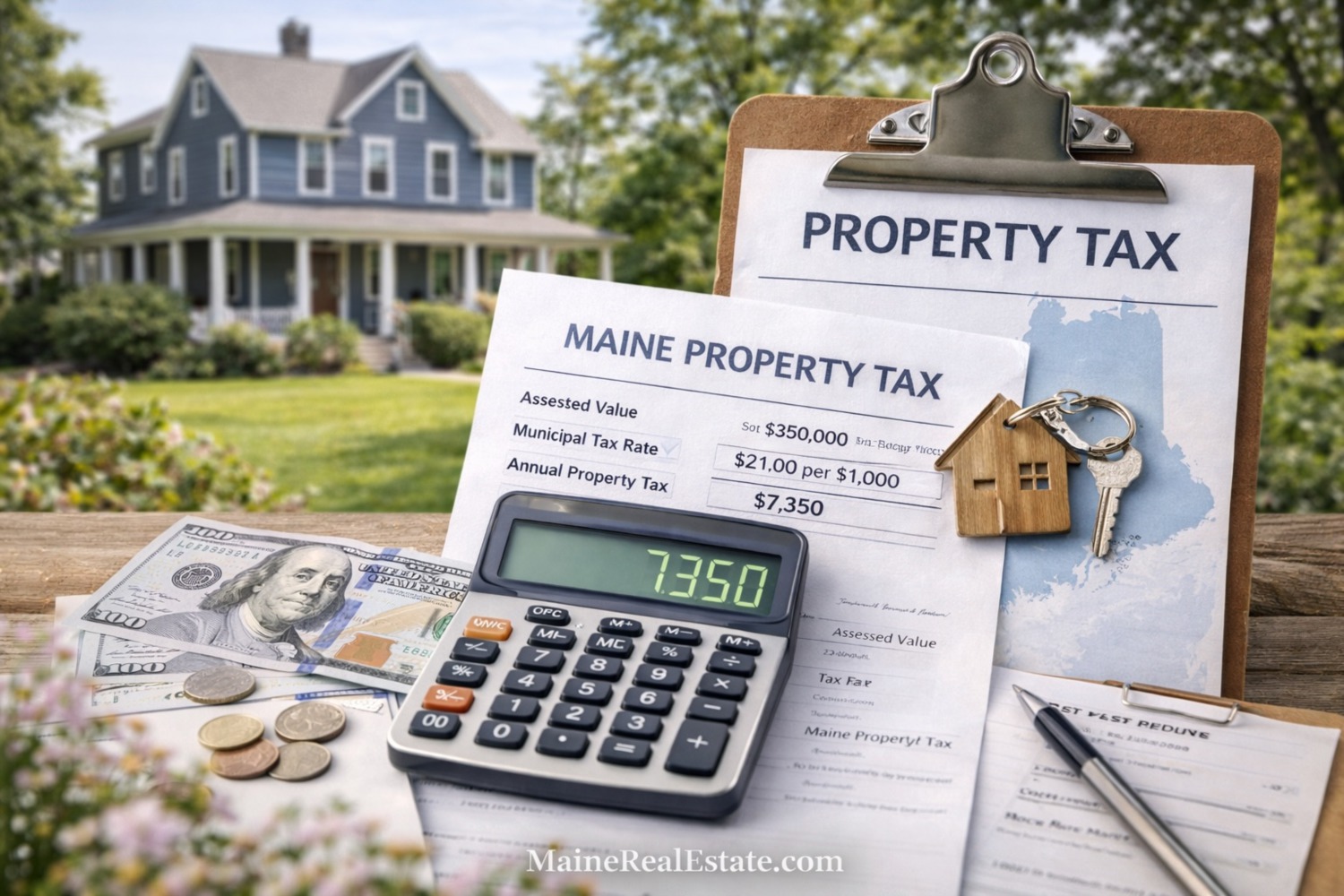
When you’re buying a home in Maine or settling into your current property, property taxes might not be the most exciting topic, but they’re absolutely one of the most important. Unlike some states where property taxes are a minor line item, Maine property taxes are a significant part of your annual housing costs. And here’s the thing: they vary wildly depending on where you live.
A three-bedroom home in Portland might carry a dramatically different tax bill than the same house in a midcoast community just 30 minutes away. Understanding how Maine property taxes work, what influences your bill, and what programs can help reduce it isn’t just useful, it’s essential to making smart real estate decisions.
This guide breaks down everything you need to know about Maine property taxes in plain English, with examples, comparisons, and actual strategies you can use. Whether you’re a first-time buyer or an existing homeowner who’s tired of guessing how your tax bill gets calculated, you’ll find the answers here.
Why Property Taxes Matter When Buying in Maine
Most people buying a home focus on the mortgage payment. That makes sense, it’s the biggest line item. But here’s what catches many new Maine residents off guard: property taxes can add $200, $300, or even $500+ per month to your housing costs, depending on location and home value.
On a $400,000 home, an effective tax rate of 1.15% means you’re paying $4,600 annually, or roughly $383 per month. That’s money that comes out of your pocket every year for as long as you own the property. Unlike a mortgage, which eventually ends, property taxes continue indefinitely.
What makes this especially important in Maine is the huge variation from town to town. Two properties worth the same amount can have vastly different tax bills depending on which municipality they’re in. This means your property tax bill should be a factor when deciding between neighborhoods, and it definitely affects what price range you can actually afford.
Calculate Your Maine Property Tax Burden
Property taxes vary dramatically by town and directly impact your true cost of homeownership. Bean Group agents know the tax situation in every Maine community. Get clarity on taxes for your target communities.
How Maine Property Taxes Work: Understanding Mill Rates, Assessed Values, and Commitments
Maine’s property tax system uses a pretty straightforward formula, but it has some unique terminology that trips people up. Let’s break it down.
The Basic Equation: Assessed Value × Mill Rate = Property Tax
Your annual property tax bill comes from two key numbers multiplied together:
- Assessed Value: The town’s official estimate of what your property is worth
- Mill Rate: The tax rate set by your municipality (expressed as mills per $1,000 of assessed value)
One mill equals $1 of tax per $1,000 of assessed value. So if a town has a mill rate of 12.5, that means for every $1,000 of assessed property value, you owe $12.50 in annual taxes.
Assessed Value: Not the Same as Market Value
Here’s where it gets interesting. Your assessed value is not necessarily what your home would sell for on the market today. Maine uses a process called “assessing” to estimate your property’s value for tax purposes. Some towns assess properties at 100% of market value. Others assess at a lower percentage.
This isn’t arbitrary, it comes down to how often towns conduct reassessments. A town that reassesses regularly (every few years) tends to be closer to actual market value. A town that hasn’t done a full reassessment in a decade might be assessing properties at 60% or 70% of current market value.
This actually matters to you. A $500,000 home assessed at 60% of value has an assessed value of $300,000. The same home assessed at 100% of value is $500,000. Even if both towns have the same mill rate, your tax bill would be dramatically different.
Mill Rate: Set by Your Municipality
Each town’s mill rate is set annually by the town council or selectboard, based on the municipal budget and total assessed property value. The rate can change year to year depending on budget needs and how property values shift.
In Maine, mill rates range from around 8 to 16+ depending on the municipality. Rural communities often have higher mill rates (sometimes because they have smaller property tax bases). Wealthier towns or those with significant commercial tax bases often have lower rates.
The Commitment: Your Annual Tax Bill
Once the assessed value and mill rate are set, the town creates a “commitment,” an official list of all properties and what they owe. This is the document your bill comes from. If you disagree with the value on the commitment, that’s what you’d appeal.
How Your Property Tax Bill Is Calculated: Step-by-Step with Real Examples
Let’s walk through how this actually works with a real example.
Example 1: A Home in Portland
You buy a home in Portland for $450,000. Portland conducts reassessments regularly, so the assessed value is close to market value: $420,000 (about 93% of purchase price, assessments often lag slightly behind sales prices).
Portland’s mill rate is 11.8.
Calculation:
- Assessed Value: $420,000
- Mill Rate: 11.8 mills per $1,000
- Tax Calculation: ($420,000 ÷ $1,000) × 11.8 = $4,956 annually
That’s about $413 per month in property taxes alone.
But wait, if you’re a Maine resident and this is your primary residence, you qualify for the Maine Homestead Exemption (more on this below).
With Homestead Exemption ($25,000 reduction):
- Adjusted Assessed Value: $395,000
- Tax: ($395,000 ÷ $1,000) × 11.8 = $4,661 annually
- Monthly: about $388
That exemption saves you about $295 per year in this scenario.
Example 2: A Home in a Midcoast Town
You buy a comparable $450,000 home in, say, Bath or Brunswick. These towns have older assessments, so the assessed value is lower, let’s say $300,000 (about 67% of market value).
Bath’s mill rate is 10.2.
Calculation:
- Assessed Value: $300,000
- Mill Rate: 10.2 mills per $1,000
- Tax: ($300,000 ÷ $1,000) × 10.2 = $3,060 annually
- Monthly: about $255
With Homestead Exemption:
- Adjusted Assessed Value: $275,000
- Tax: ($275,000 ÷ $1,000) × 10.2 = $2,805 annually
- Monthly: about $234
The Difference
Same $450,000 home. Portland: $388/month with exemption. Bath: $234/month with exemption. That’s $154 per month difference, or nearly $1,850 per year. Over 10 years, you’d pay nearly $18,500 more in property taxes in Portland for an identical property.
This is why location matters so much for property taxes in Maine.
Property Tax Rates Across Maine: Regional Breakdown
Maine’s effective property tax rates vary significantly by region. The state average effective tax rate (what percentage of home value goes to taxes) is around 1.09% to 1.30% depending on the year, but that average masks huge regional variations.
Portland and Southern Maine (Higher Rates, Higher Values)
Portland, one of Maine’s most desirable areas, has seen significant property value increases in recent years. Mill rates hover around 11 to 12, and because assessments are relatively current, effective tax rates can hit 1.25% to 1.35%.
Why higher? Popular, developed areas with rising property values, significant infrastructure needs, and active downtown districts.
Towns in this category: Portland, South Portland, Cape Elizabeth, Yarmouth, Freeport, Wells
Southern Maine Suburbs and Coast (Moderate to High)
Communities like Scarborough, Biddeford, Old Orchard Beach, and Kennebunk have moderate to high property values with mill rates ranging from 10.5 to 12.5. Effective rates typically fall between 1.10% and 1.25%.
Midcoast Region (Moderate)
Brunswick, Bath, Camden, Rockland, and Damariscotta offer a sweet spot for many Maine buyers, lower tax rates than Portland without venturing too far north. Mill rates typically range from 9.5 to 11.5, and lower assessment ratios keep effective rates around 1.00% to 1.15%.
Bangor Area (Moderate to Moderate-High)
Bangor and surrounding communities (Orono, Old Town) have moderate mill rates (10 to 11) but varying assessment ratios. Effective rates typically fall around 1.15% to 1.25%.
Rural Northern and Western Maine (Variable)
Communities in Somerset, Piscataquis, Aroostook, and Oxford counties typically have lower property values but sometimes higher mill rates due to smaller property tax bases. Effective rates can range from 0.95% to 1.30% depending on the specific town.
The catch: Lower property values mean lower tax bills in dollars, but mill rates are often higher.
Island Communities (Generally Higher)
Islands like Mount Desert Island and the Blue Hill area have experienced significant valuation increases. Combined with the costs of island infrastructure, mill rates can be 11 to 13+, and effective rates can approach 1.30% to 1.40% or higher.
The Maine Homestead Exemption: Who Qualifies and How Much It Saves
One of the most valuable property tax programs Maine offers is the Homestead Exemption. If you own your home and it’s your primary residence, you likely qualify for this.
What It Does
The Homestead Exemption reduces your taxable assessed value by $25,000. This reduction applies to your property tax calculation, lowering what you owe each year.
In dollars: On a property with an 11-mill rate, a $25,000 exemption saves you $275 annually. On a 12-mill rate, it saves $300. It might not sound enormous, but over 20 years of ownership, that’s $5,500 to $6,000 in savings.
Who Qualifies
You qualify if:
- You own the property
- You occupy the property as your primary residence on April 1st of the tax year (Maine’s valuation date)
- You’ve lived in Maine for at least 12 months
- You’re a U.S. citizen or legal resident alien
How to Apply
Contact your town’s assessor’s office and request the Homestead Exemption form. Most towns allow you to apply online, by mail, or in person. There’s no fee. You typically only need to apply once, the exemption continues unless you move or change your occupancy status.
If you buy a home during the year, you might not qualify for the exemption until the following year, so don’t count on it in your first year as an owner.
What It Doesn’t Apply To
The Homestead Exemption applies only to your primary residence. If you own a vacation home, investment property, or second home in Maine, that property doesn’t qualify.
Other Tax Relief Programs in Maine
Beyond the Homestead Exemption, Maine offers several other programs to reduce property taxes for specific groups.
Property Tax Fairness Credit
This program helps lower-income Maine residents. If your household income is below certain thresholds (roughly $36,500 to $50,000 depending on household size), you may qualify for a credit on your state income taxes based on your property taxes paid.
It’s not a direct reduction of your property tax bill, but rather a credit against your state income taxes. You need to apply through your state tax return. This program is particularly valuable for residents and fixed-income households.
Veteran Exemptions
Maine offers property tax exemptions for eligible military veterans:
- Disabled Veteran Exemption: Up to $50,000 of assessed value exemption for veterans with service-connected disabilities rated by the Veterans Administration
- Veteran Exemption: A smaller exemption for other eligible veterans
The amount varies by town, and you’ll need to provide documentation from the VA.
Blind Exemption
Residents who are legally blind may qualify for a property tax exemption. The amount varies by municipality.
Tree Growth, Farm, and Open Space Programs
Maine offers tax incentive programs for property owners who maintain their land for forestry, farming, or open space purposes:
Tree Growth Tax Law: If you own at least 10 acres of forest land enrolled in the program, you pay taxes based on the land’s value for timber production rather than its market value. For properties that might otherwise be worth hundreds of thousands as development land, this can reduce taxes dramatically.
Farmland Program: Working farms can qualify for lower assessment values based on agricultural use rather than development potential.
Open Space Program: Properties preserved for open space conservation can receive assessment breaks.
These programs make sense if you own significant acreage. The trade-off is that your land is restricted from development as long as you’re enrolled.
How Reassessments and Revaluations Work
One factor that dramatically affects your property tax bill over time is how your town conducts reassessments. Understanding this helps you anticipate future tax bill changes.
When Do Reassessments Happen?
Maine towns conduct reassessments on varying schedules:
- Some towns reassess every 3 to 5 years
- Others have gone a decade or more without a full reassessment
- A few towns conduct ongoing reassessment programs
When a town does a major reassessment, property values typically jump to reflect current market conditions. You might see your assessed value increase 20%, 30%, or more in a single year.
Revaluation vs. Reassessment
These terms are often used interchangeably, but technically:
- Reassessment updates values based on recent sales and market conditions
- Revaluation is a comprehensive property-by-property review
Both can result in significant value increases for individual properties.
Why This Matters to You
If your town hasn’t had a full reassessment in many years, you might be assessed at 60 to 70% of market value. When reassessment happens, and it eventually does, expect your assessed value and tax bill to jump significantly.
This is happening in some Maine communities right now. After years of skipping reassessments, rising home values are forcing towns to revalue properties, leading to sudden tax bill increases that shock homeowners.
The Silver Lining
After a revaluation, values stabilize for a few years. Once the shock passes, annual increases are typically more modest (2% to 4% per year) as the town makes smaller adjustments annually or biannually.
Appealing Your Property Tax Assessment
If you believe your property has been assessed too high, you have the right to appeal.
The Process
- Get the details: Request the property record card from your assessor’s office. This shows how your property was valued and what comparable sales were used.
- Gather evidence: Document your property’s actual condition. If it needs major repairs, has boundary issues, or has other defects that would lower value, get these in writing.
- Find comparable sales: Look at actual sales of similar properties in your area. If homes similar to yours sold for less than your assessed value suggests, you have a case.
- File an appeal: Contact your assessor by the deadline (usually early in the year, check your town’s specific date). The form is typically called an “Application for Abatement” or “Abatement Request.”
- Meet with the assessor: Many appeals are resolved at this stage. The assessor can provide perspective and may adjust the value if you have strong evidence.
- Board of Assessment Appeals: If you can’t reach agreement, you can appeal to your town’s Board of Assessment Appeals (most towns have these).
- Court: If necessary, you can appeal to Maine’s courts, though this is rarely necessary or cost-effective.
Timing Is Critical
Don’t wait. Abatement requests usually have early-year deadlines. Missing the deadline means you have to wait until the following year. Once a tax bill is issued, you’re obligated to pay it even while appealing, though if you win, you get a refund.
Should You Appeal?
If your assessment is clearly out of line with recent comparable sales (you found similar homes that sold for 10 to 15% less), an appeal is worthwhile. The cost is minimal (just your time), and you might save hundreds or thousands annually.
Assessment Too High?
If you believe your property is overassessed, you have options. An appeal can save you significant money over time. Reach out to us for guidance on your specific situation.
Property Taxes and Waterfront or Vacation Homes: Non-Homestead Properties
If you own a second home, vacation property, or waterfront lot in Maine, different rules apply.
Non-Homestead Properties Don’t Get the Exemption
Your $25,000 Homestead Exemption applies only to your primary residence. Vacation homes, investment properties, and second homes are assessed at full value with no exemption.
Higher Effective Tax Rates
Waterfront and vacation properties often face effective tax rates higher than your primary residence because:
- They’re assessed at full market value (no exemption)
- Waterfront locations have premium values
- Mill rates in scenic areas can be high due to infrastructure and services
A $600,000 waterfront property might face an effective tax rate of 1.25% to 1.35%, costing $7,500 to $8,100 annually just in property taxes.
Budget Accordingly
When buying a vacation or investment property, factor the property taxes into your overall return calculation. On vacation properties especially, property taxes are a significant ongoing cost beyond your mortgage.
How Property Taxes Affect Your Home Buying Budget
When you’re getting a mortgage preapproval, lenders typically don’t emphasize property taxes enough. But they should. Property taxes affect both your ability to qualify for a loan and your actual monthly housing costs.
The Debt-to-Income Ratio
Lenders calculate your debt-to-income ratio (DTI) using gross monthly income against all monthly debts and obligations. Property taxes count toward your housing expense, which is part of this calculation.
Example: You have a $3,500 monthly mortgage payment. Your property taxes are $400/month. Your homeowner’s insurance is $150/month. Your housing expense is $4,050, which is weighed against your gross income to determine if you qualify.
If property taxes are $250 instead of $400, you can potentially qualify for a larger mortgage.
Real Cost of Ownership
Banks will calculate a housing expense ratio, but your actual monthly cost is what matters for your budget. Two homes with the same mortgage payment but different property taxes are not the same cost.
This is why property tax variation by town matters so much: If you’ve budgeted $1,800/month for your house payment but didn’t account for property taxes being $400 instead of $200, you’re off-budget by $200/month. Over a year, that’s $2,400 you didn’t plan for.
The Smart Approach
When comparing homes or neighborhoods:
- Get an estimate of property taxes from the town assessor
- Add taxes + mortgage + insurance + HOA fees (if applicable) = your true monthly housing cost
- Make sure this number fits your budget
- Remember that property taxes can increase, especially post-reassessment
Don’t just focus on the mortgage. Your total housing cost is what matters.
Property Tax Trends in Maine: Understanding What’s Changing
If you own property in Maine or are planning to buy, understanding current trends helps you anticipate future tax bills.
Rising Valuations, Squeezed Residents
Over the past decade, Maine property values have increased significantly in many communities, especially in southern Maine and around Portland. Property values have roughly doubled or more in many desirable areas.
The problem: while property values rise, incomes don’t always keep pace. Homeowners who bought years ago at lower values now find their property taxes increasing as reassessments happen. Long-time residents are being priced out of their own communities by rising tax bills.
Municipal Budget Pressures
Most Maine towns struggle with tight budgets. Aging infrastructure, education funding, and service demands keep municipal budgets constrained. Some towns solve this with higher mill rates; others try to increase the tax base by encouraging development.
The result: Mill rates aren’t dropping. Property taxes continue climbing.
Statewide Reassessment Movement
Some municipal leaders are recognizing that outdated assessments are unfair and unsustainable. A push is underway in some areas for more frequent, modern reassessments. This will be painful for homeowners in the short term but creates more equitable taxation long-term.
The 2025 to 2026 Environment
As of 2025 to 2026, Maine is experiencing:
- Continued pressure on residential property values due to limited inventory and demand
- Rising mill rates in many communities due to municipal budget needs
- Increased attention to property tax relief programs, especially for residents and fixed-income households
- Ongoing discussions about whether Maine’s property tax burden is sustainable long-term
For buyers and current owners, this suggests property taxes will likely stay elevated or increase further.
Smart Strategies for Managing Your Maine Property Tax Burden
You can’t eliminate property taxes, but you can manage them strategically.
1. Claim the Homestead Exemption
If you haven’t applied, apply immediately. It’s free, and even a few hundred dollars per year adds up over time.
2. Consider Mill Rate When Choosing a Town
A 15-minute difference in commute might mean a 1 to 2 mill rate difference, translating to hundreds of dollars annually. Factor this into your location decision.
3. Explore Tax Relief Programs if Eligible
If you’re a veteran, low-income, or qualify for other programs, apply. The application process is usually simple, and the benefits are real.
4. If You Own Land, Explore Tree Growth or Farm Programs
If you own 10+ acres of forest or working farmland, these programs can dramatically reduce your tax burden. A parcel worth $600,000 as development land might be taxed like $200,000 of forest land.
5. Appeal Clearly Excessive Assessments
If you buy a property and it’s quickly reassessed significantly higher, you have a right to appeal. If comparable sales data supports a lower value, make your case.
6. Budget for Future Increases
Assume your property taxes will increase 2% to 4% annually. Some years they’ll jump more if reassessments happen. Budget conservatively.
7. Monitor Your Town’s Mill Rate
Attend town meetings or review budget documents. If your town is discussing mill rate increases, you might have warning to adjust your budget or appeal an assessment.
8. Track Your Assessment Record
Keep a file with your property record card, past tax bills, and assessment details. This makes future appeals easier and helps you track whether assessments are keeping pace with market values.
9. Remember the Bigger Picture
Property taxes are high in Maine, but so is the quality of life, natural beauty, and community character that those taxes fund. Schools, infrastructure, emergency services, and public lands are supported by these taxes. Understanding this context doesn’t eliminate the burden, but it provides perspective.
10. Plan for the Long Term
If you’re a long-term Maine homeowner, property taxes are a permanent part of your housing costs. Don’t just focus on your mortgage. Ensure your overall financial plan accounts for ongoing property tax obligations that will likely increase over the decades you own the home.
Make Smart Property Tax Decisions with Bean Group
Property taxes significantly impact your real estate costs. Understanding the tax implications of different Maine towns helps you choose wisely and budget accurately. Bean Group agents know the property tax situation in every community and can help you understand the true long-term cost of ownership. Connect with our tax-savvy agents to discuss your Maine home purchase.
Final Thoughts: Property Taxes in Context
Maine property taxes are complicated, varied by location, and for many residents, a genuine financial burden. But they’re also manageable and knowable.
The key is understanding how they’re calculated, what programs can help, and how they fit into your overall financial picture. By tackling this topic head-on, rather than ignoring it or hoping it goes away, you put yourself in control.
Whether you’re buying your first Maine home or reassessing your property tax situation after decades of ownership, the information in this guide should give you the clarity you need to make smart decisions.
Your property taxes matter. They deserve your attention. And with the right knowledge, you can manage them effectively.
Have questions about your specific property or situation? Contact your town’s assessor’s office, they’re a surprisingly useful resource, and it’s literally their job to help you understand your taxes.
Looking to reduce your bill? Start with ensuring you’re claiming every exemption and program you qualify for. The money you save is time well spent on research.
Buying in Maine soon? Request specific property tax information early in your search process. Factor it into your decision. And remember: the cheapest mortgage isn’t necessarily the cheapest house when you account for property taxes.
Frequently Asked Questions
What is a mill rate, and how does it affect my property taxes?
A mill rate is the tax rate set by your municipality, expressed as dollars per $1,000 of assessed property value. One mill equals $1 in taxes per $1,000 of assessed value. So a mill rate of 12 means you pay $12 per $1,000 of assessed value annually. Mill rates directly affect your tax bill, so even small differences between towns can result in significant annual savings or costs.
Is my assessed value the same as my home’s market value?
Not necessarily. Assessed value is the town’s official estimate of your property’s value for tax purposes, while market value is what your home would sell for today. Some towns assess at 100% of market value, while others assess at lower percentages (60%, 70%, etc.). The percentage depends on how frequently the town conducts reassessments. Towns with recent assessments tend to be closer to market value, while towns with outdated assessments may be significantly lower.
How much money will the Homestead Exemption save me?
The Homestead Exemption reduces your assessed value by $25,000. The actual dollar savings depends on your mill rate. At an 11-mill rate, you save $275 annually. At a 12-mill rate, you save $300. Over 20 years, that’s $5,500 to $6,000 in savings. While this might not sound enormous, it’s money back in your pocket that requires just one-time application.
Why do property taxes vary so much between Maine towns?
Property taxes vary between towns for several reasons: (1) different mill rates based on municipal budgets and needs, (2) different assessment ratios (some towns assess at 100% of market value, others at lower percentages), (3) different property values (wealthy towns typically have lower rates), and (4) different assessment ages (towns with recent reassessments have values closer to market). A 15-minute commute difference can mean hundreds of dollars in annual tax savings.
What should I do if I think my property assessment is too high?
First, request your property record card from your assessor’s office to understand how your value was determined. Then research comparable sales of similar properties in your area. If you find homes similar to yours that sold for significantly less than your assessed value suggests, you have grounds for appeal. File an “Application for Abatement” with your town assessor by their deadline (usually early in the year). Many appeals are resolved at the assessor level. If not, you can appeal to your town’s Board of Assessment Appeals.
How often do towns reassess properties, and what happens when they do?
Reassessment schedules vary. Some towns reassess every 3 to 5 years, while others haven’t reassessed in a decade or more. When a reassessment happens, property values typically jump significantly as they’re updated to reflect current market conditions. You might see your assessed value increase 20%, 30%, or more in a single year. After reassessment, annual increases typically moderate to 2% to 4% per year.
Does the Homestead Exemption apply to vacation homes and investment properties?
No. The $25,000 Homestead Exemption applies only to your primary residence. Vacation homes, investment properties, and second homes are assessed at full market value with no exemption. This means vacation and investment properties carry higher effective tax rates than your primary home and are a significant ongoing cost to factor into your purchase decision.
What are some strategies I can use to reduce my property tax burden?
Several strategies can help: (1) apply for the Homestead Exemption if you haven’t already, (2) consider mill rate when choosing between towns (a 1 to 2 mill rate difference equals hundreds in annual savings), (3) apply for tax relief programs if you’re eligible (veteran exemptions, low-income credits), (4) if you own forest or farmland, explore Tree Growth or Farmland programs, (5) appeal excessive assessments with comparable sales data, (6) budget for 2% to 4% annual increases, (7) monitor your town’s budget and mill rate changes, and (8) maintain detailed assessment records for future appeals.